
Java vs. JavaScript: The Naming Confusion That Won’t Die
Introduction
Many people starting out to learn coding or just gathering information on computers and internet may encounter two names: Java and Java Script (JS) along the journey… These names stand for two programming languages and there is one huge problem: despite the similarity in naming, they could hardly be more different. Still, every day thousands of users ask (themselves or Google): is Java and JS the same? Are these two different spellings of the same name or two slightly different names for the same language? The short answer to such doubts: No, they are not the same! Java and JS are two completely different programming languages, and by different it means almost everything: history, origin, purpose, syntax, difficulty level and popularity. For the comprehensive answer, keep reading, because this article aims to clear all misconceptions about JS and Java and give you the peace of mind, as you can check the next box on your list ‘What I have always wanted to understand about computers’.
I. Java – History of a Hidden Champion
When Java was introduced by Sun Microsystems in 1995, it carried a promise that sounded almost magical: “Write once, run anywhere.” With the help of the Java Virtual Machine (JVM), a program written in Java could run on Windows, Mac, or Linux without rewriting a single line of code. For developers of the 1990s, this was revolutionary.
But with that fame came a shadow. Many people still remember the “Java security warnings” popping up in their browsers in the early 2000s. Java applets — those little programs that ran inside a web browser — became notorious for their vulnerabilities. At first, they were wildly popular: countless browser-based games, interactive animations, and free utilities spread like wildfire across the internet. For a while, they made the web feel exciting and alive. The flip side of this popularity was exposure. Because applets were often downloaded from unverified sources, attackers had an easy entry point. Weak sandboxing and missing restrictions in the browser made exploitation simple, and millions of casual users who just wanted to play a game or run a free tool suddenly became potential victims.
It’s worth noting that Java was not alone in this. Adobe Flash, another technology of the same era, powered much of the early web’s games and animations and suffered from similar security headaches. The crucial difference was that while Flash eventually disappeared entirely, Java continued to thrive outside the browser. The problem wasn’t the language itself but the insecure environment in which it was forced to run.
Outside the browser, Java was quietly building a completely different image. It became the workhorse of the business world — the hidden champion behind banking systems, large-scale enterprise applications, and, later, the Android ecosystem. The fact that so many mission-critical industries rely on Java is itself a proof of trust: if a language were truly unsafe or obsolete, no bank, insurance company, or telecom giant would bet billions of transactions per day on it.
Today, Java might not be the trendiest language. Some call it “boring,” with its strict rules and verbose syntax. But boring in software often means reliable, mature, and well-understood. In a world where hype comes and goes, Java has quietly remained one of the most used and respected programming languages for nearly three decades. That kind of longevity isn’t an accident — it’s the result of stability, ongoing development, and a global community that continues to trust it.
II. JavaScript – From Giggles to the WWW
If Java was the serious, disciplined student of the mid-1990s, JavaScript was the class clown that somehow ended up changing the whole school. Its story begins at Netscape in 1995, when Brendan Eich was asked to create a lightweight scripting language for the web browser. The timeline was absurd: he had about ten days. Out of that sprint came the first version of JavaScript.
The naming of the language is perhaps one of the funniest twists in tech history. Eich originally called it Mocha, later LiveScript. But just as the product was being launched, Netscape and Sun Microsystems struck a marketing deal: riding the wave of Java’s hype, they renamed it JavaScript. The goal was simple — if Java was hot, then surely something called JavaScript must be hot too. From a branding perspective, it was a clever move. From an educational perspective, it was a disaster that continues to cause confusion almost thirty years later. Usually, inventors fight tooth and nail to avoid their new product being mistaken for an existing one; in this case, they did the exact opposite — and the internet is still laughing (and Googling “Java vs JavaScript”) about it.
Beyond the naming trick, JavaScript quickly proved its worth. While Java was powering servers and enterprise applications, JavaScript brought life to the web. Buttons that actually did something when you clicked them, drop-down menus, form validations — all of these became possible thanks to JavaScript. Over time, it evolved far beyond those early gimmicks. Today, with frameworks like React, Angular, and Vue, JavaScript dominates the frontend world, while Node.js has made it a strong player on the server side as well. What started as a quick hack in a browser is now the backbone of modern web applications.
In terms of reputation, JavaScript has always been a little chaotic. Its syntax is forgiving to a fault, leading to quirky behaviors that confuse beginners and veterans alike. Yet this very flexibility has made it one of the most powerful tools in a developer’s arsenal. It is dynamic, interpreted, and easy to get started with, which means beginners can see results within minutes. At the same time, its depth and ecosystem mean that entire companies and platforms run almost exclusively on JavaScript.
In short, what began as a “for giggles” naming stunt has grown into one of the most important languages of the internet age. If Java is the hidden champion, then JavaScript is the accidental superstar — a language that stumbled into existence but went on to define the way we all experience the web.
III. Comparing Java vs. JavaScript
Now that we’ve seen the very different journeys of Java and JavaScript, it’s time to look at them side by side. The first thing to note is that they don’t even belong to the same category of languages. Java is a compiled, class-based, strongly typed language that enforces structure and rules. JavaScript, by contrast, is interpreted (though modern engines apply Just-In-Time compilation for speed), loosely typed, and designed to be flexible.
They also live in different environments. Java runs on the Java Virtual Machine (JVM), which allows programs to work across operating systems. JavaScript was born in the browser, but has since broken free of it. Thanks to Node.js, JavaScript now runs servers too, making it a true full-stack language.
The ecosystems reflect this split. Java remains the backbone of large-scale enterprise systems, Android applications, and industries that prize stability. JavaScript, on the other hand, powers the modern web: the trio of HTML, CSS, and JavaScript form the foundational pillars of every website. Without JavaScript, the web would still be a collection of static pages.
It’s also worth mentioning the role both languages play for beginners. JavaScript, alongside Python, is considered one of the most accessible programming languages for newcomers. The syntax feels less abstract, closer to natural language, and the effects are immediate: type a few lines of code, reload the browser, and you see the result. This instant feedback loop is motivating in a way that more structured languages like Java sometimes can’t match. Java may be better for building a strong foundation in software engineering principles, but for sheer accessibility and quick results, JavaScript is often the easier first step.
Both languages are incredibly popular — but for very different reasons. Java is trusted in industries where failure is not an option, while JavaScript is essential wherever people interact with the web. Together, they illustrate how different philosophies can both achieve massive, lasting success.
Strongly Typed vs. Loosely Typed Languages
- Strongly Typed (e.g., Java): Every variable has a fixed type (like
int,String,boolean). The compiler checks and enforces these rules before the program even runs. This reduces errors but makes the code more verbose. - Loosely Typed (e.g., JavaScript): Variables can change type on the fly. You can assign a number to a variable, then later replace it with text. This makes coding fast and flexible, but can also lead to unexpected bugs.
- Why It Matters: Strong typing = more safety and predictability. Loose typing = faster prototyping and easier learning curve.
| Aspect | Java | JavaScript |
|---|---|---|
| Year of Birth | 1995, Sun Microsystems (James Gosling) | 1995, Netscape (Brendan Eich) |
| Initial Purpose | Platform-independent enterprise applications | Add interactivity to websites |
| Execution | Compiled → runs on the JVM | Interpreted / JIT → runs in browsers & Node.js |
| Typing | Strongly typed, class-based OOP | Loosely typed, prototype-based |
| Typical Use Cases | Banking systems, Android apps, enterprise software | Web development (frontend) & backend with Node.js |
| Beginner-Friendliness | Steeper curve; strong foundations in OOP & structure | Fast start; immediate visible results in the browser |
| Ecosystem | Enterprise, Android, mission-critical systems | HTML/CSS/JS → pillars of the web; full-stack apps |
| Popularity Today | Backbone of large corporations & Android ecosystem | Dominant across modern web development |
Hello World: A Tale of Two Languages
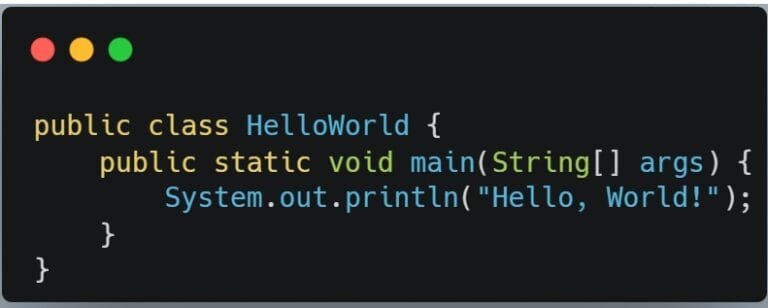
Sometimes the difference between Java and JavaScript is easiest to see in the simplest example: printing “Hello, World!”.
In JavaScript, it takes just a single line:
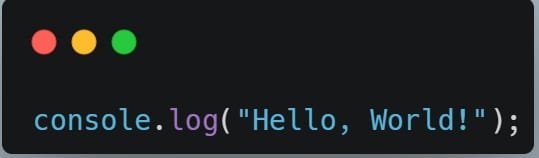
That’s it. Open the browser console, type it in, and you see the result instantly. This simplicity is one reason JavaScript is considered beginner-friendly — fast, visible results with very little overhead.
In Java, the same program requires a full class structure:
IV. Conclusion
Java and JavaScript may share a name and a birth decade, but that’s where the similarities end. The naming stunt of the 1990s has created decades of confusion, yet the truth is simple: these are two entirely different languages, living in different worlds — and both indispensable in their own right.
Think of Java as a freight train: powerful, heavy, structured, built to carry enormous loads safely across long distances. Behind the scenes, much of our modern infrastructure depends on it. From banking systems to mobile networks to Android apps, Java ensures stability where failure is not an option.
JavaScript, by contrast, is like a scooter weaving through city traffic: flexible, everywhere, sometimes a little chaotic, but the reason the modern web feels alive. Without JavaScript, we would still be clicking through static pages. Today, it is one of the three essential pillars of the web — alongside HTML and CSS — and has evolved into a versatile ecosystem powering everything from interactive dashboards to 3D websites, frameworks like Vue, and even ambitious visions of the Metaverse. For beginners, its accessible syntax and instant, visible results make it one of the best ways to dip a toe into programming.
The important thing to remember is this: while Java and JavaScript could hardly be more different, they are both heavy lifters in their own domains. One carries the weight of industries and global infrastructure, the other powers the web that we touch every day. Understanding this distinction is more than trivia — it’s an “aha!” moment for anyone on their coding journey. Now, the next time you encounter the names side by side, you’ll know: Java is not JavaScript, and both deserve respect for the very different ways they shape our digital world.
Bonus Material
If you’d like to dive even deeper into the story of JavaScript, here’s a real treat: a talk by Brendan Eich, the creator of JavaScript, hosted by freeCodeCamp.
For those who don’t know it yet, freeCodeCamp is one of the world’s most popular open learning platforms for programming and computer science. It offers high-quality, free tutorials and courses, and their YouTube channel is full of excellent talks and technical deep-dives.
In this particular talk, Brendan Eich reflects on the creation of JavaScript, its evolution, and the state of web technologies today. It’s an unmissable watch if you want to understand not only how the language came to life in just ten days, but also how it shaped the internet we use every day.